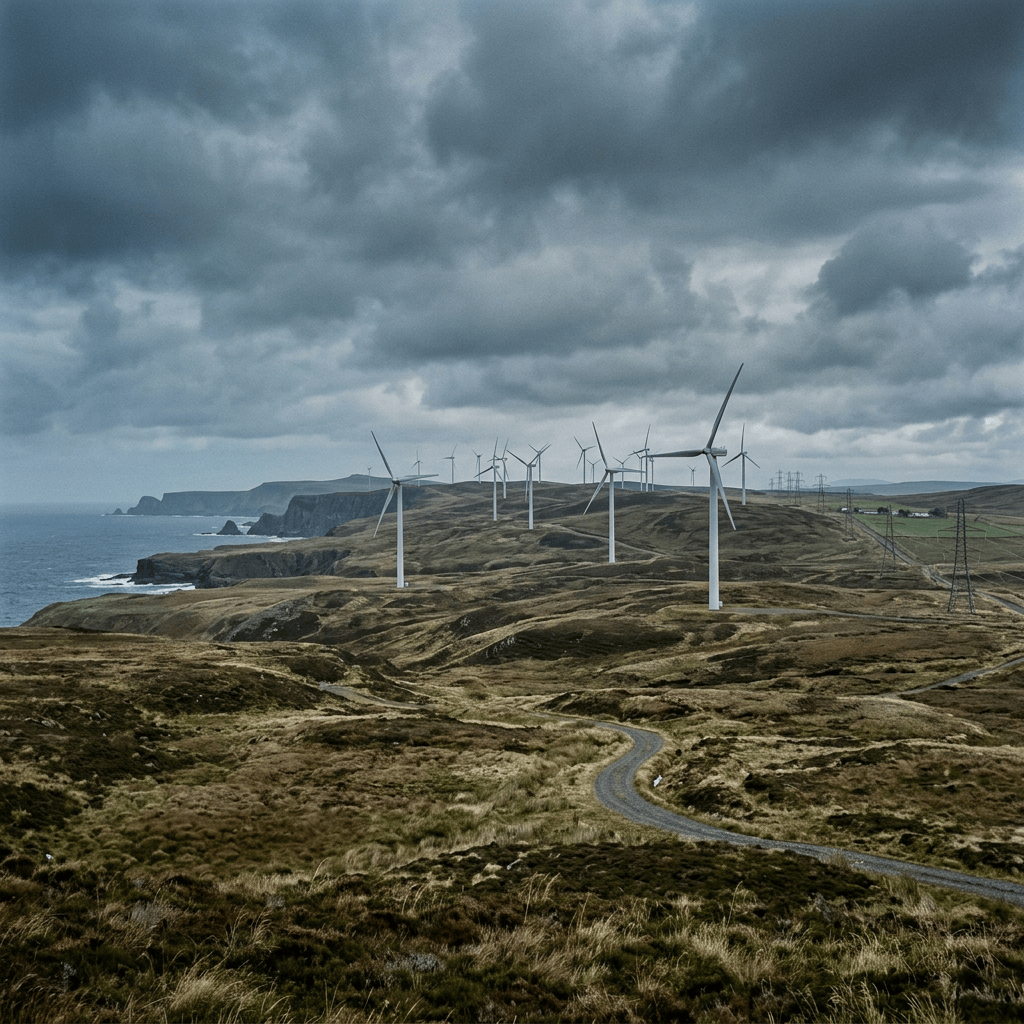
Drive anywhere in Caithness and you will see them: wind farms on almost every horizon, and more on the way. On a breezy day you might expect every blade to be turning. Often they are not.
Meanwhile our electricity bills keep climbing. Many of us are left asking a simple question. If so much power is made on our doorstep, why are we paying more for it than almost anyone else in Britain?
This piece sets out who pays for wind farms, why so many stand idle, and what could change.
Who pays for wind farms?
Mostly, we do, through our electricity bills rather than our taxes. Two schemes pay renewable generators extra on top of the price of the power they sell:
- The Renewables Obligation (RO), which closed to new projects in 2017 but still covers about three quarters of UK wind and solar power.
- Contracts for Difference (CfD), which guarantee newer projects a fixed price.
Together these schemes cost around £9.9 billion in 2024. They also cover solar and some other generation, not just wind.
This year something changed. In the Autumn Budget 2025 the government decided to move much of the RO cost off bills and onto general taxation. The OBR put the cost of that at around £2.3 billion between 2026 and 2029. So for the first time, a real share of the bill is being paid through our taxes instead.
Paying them to switch off
Those idle turbines are often being paid to stand still. When the grid cannot carry the power south, the National Energy System Operator (NESO) pays wind farms to cut their output. It then pays gas power stations further south to make up the shortfall.
The cost of this hit a record £1.46 billion in 2025, up from £1.23 billion in 2024. Surprisingly, most of that money goes to gas plants, not wind farms. Payments to the wind farms themselves were about £380 million in 2025.
NESO recovers the cost through a charge on electricity suppliers, who pass it straight on to us. In 2023/24, these payments made up about 2.4% of a typical bill. In 2024, 98% of the money paid to switch off wind went to Scottish wind farms.
Why so many here?
Caithness produces far more electricity than it could ever use. That is not an accident. Northern Scotland has some of the strongest, steadiest wind in Europe, land is cheaper, and there are fewer neighbours to object.
Planning rules played a big part too. For almost a decade, from 2015 until 2024, it was close to impossible to get a new onshore wind farm approved in England. Scotland kept saying yes, so the developers came here.
The problem is that nobody built the cables at the same pace. Generation raced ahead of the grid, and we are all paying for the gap.
Producers, but no discount
Here is the part that stings. Living beside the generation brings us no cheaper power at all. Everyone in Britain pays the same national wholesale price.
Worse, the North of Scotland has some of the highest electricity standing charges in the country, because network costs are spread across a small, scattered population. Many homes here are off the gas grid and heat with electricity, so we feel every price rise more than most.
There was a proposal that could have changed this. Zonal pricing would have split Britain into regions, with cheaper power where it is generated and dearer power where it is used. Supporters said it could have lowered bills in places like ours. In July 2025 the government rejected it and kept a single national price.
The other side of the argument
In fairness, not everyone sees it this way.
- The wind farms are in the right place. A turbine here produces far more than one in the south, so supporters argue it is cheaper overall to build here and fix the cables.
- Switching off is normal. Grid operators pay any generator, gas included, to reduce output when needed. NESO says building enough cables to avoid it entirely would cost even more.
- Wind lowers prices elsewhere. When the wind blows, it pushes down the wholesale price, and newer CfD wind farms pay money back when prices are high.
- Zonal pricing had risks. The government and some investors warned it would raise costs elsewhere and scare off investment. ScottishPower welcomed its rejection, while Octopus Energy warned it would lock in higher costs for years.
What now?
Whatever side you take, most people agree the current waste is too high and the grid upgrades are long overdue. The government is preparing a national plan for where future generation should go. For Caithness, much of it is already built.
Wind farm community benefit funds do support local projects, but many feel they are small compared with what living beside the generation should be worth.
If you feel strongly, make your voice heard:
- Write to your MP, your MSPs and your Highland councillors and ask where they stand on cheaper power for generating areas.
- Ask your supplier how much of your bill goes on network and balancing charges.
- Share your own experience in the comments. Has your bill gone up? Do you heat with electricity?
We would like to hear from you.
Sources
- UKERC response to the Autumn Budget 2025
- Solar Power Portal: government to cover policy costs
- Hansard: Renewables Obligation (Amendment) Order 2026
- Energy Voice: constraint payments to Scottish wind farms
- Constraint costs hit £1.46bn in 2025
- Telegraph via Yahoo: paying to switch off wind farms
- Strathclyde Centre for Energy Policy: zonal pricing decision
- The Energyst: reactions to zonal pricing decision
- UK Government CfD AR7 impact assessment


Leave a Reply