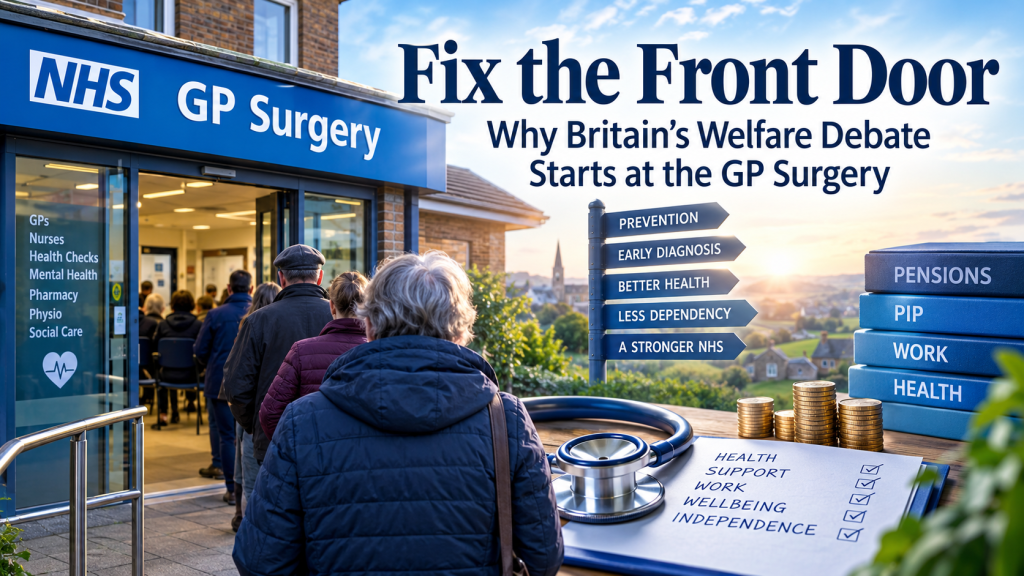
If you read the papers, Britain’s welfare bill is “out of control”. The solution offered is always the same: cut disability benefits and get people back to work. I spent my working life as an engineer, and engineers are taught one thing before anything else. Find the real fault before you start replacing parts.
So I went and looked at the numbers. What I found is a story that starts not at the Jobcentre, but at the GP surgery.
What the welfare bill really is
The biggest item in the welfare bill is the state pension, and it always has been. The first old age pension arrived in 1908, and the National Insurance system launched in 1948 put it at the heart of social security. It was never quietly added later.
Total UK welfare spending was £314.9bn in 2024/25, about 10.7% of the economy. Around 55% of it goes to pensioners, with the state pension alone forecast at £146.1bn in 2025/26.
Here is the part the headlines leave out. As a share of national income, welfare spending rose from the late 1940s to the early 1980s and has broadly levelled off since. Working age benefits cost about the same share of GDP in 2011/12 as in 1982/83. The growth is coming from an ageing population and the triple lock, not from a sudden explosion in people refusing to work.
The PIP puzzle
Personal Independence Payment is where the political fire is aimed, and there is a reason. It is the fastest growing part of the bill: £16.3bn in 2019/20 in today’s prices, £27.3bn by 2024/25, and forecast to reach £41.5bn by 2030/31.
But PIP is not an out of work benefit. It helps disabled people with the extra costs of daily living and getting around, and it is paid whether or not you have a job. Many PIP claimants work. Cutting it does not create a single job; it just makes life harder for people already managing a condition.
So why are more people claiming? The honest answer is that nobody fully knows. Long NHS waits, rising mental ill health and people struggling for years without diagnosis or treatment are all part of it. Which brings us to the real question. If people are sicker, why are we arguing about benefit rules instead of health?
Back to work, but which work?
The “get people back to work” message also assumes the jobs will be there. With AI already changing offices, call centres and back room work, that feels like thinking from another decade. Even the government’s own investment minister, Jason Stockwood, said in January that a universal basic income might be considered to soften AI job losses, though it is not official policy.
I’m not convinced a basic income for everyone is affordable. £1,000 a month for every adult would cost roughly double today’s entire welfare bill, and it would not cover the extra costs of disability anyway. Wales paid care leavers a basic income for two years and found real benefits to their wellbeing, but the results on employment are not due until 2027. It is a debate worth having, but it is not the first fix. The first fix is health.
Health is the real lever
A healthier population needs fewer benefits, works longer and costs the NHS less. Better mental health support in particular could stop mild problems becoming long term illness. The government says its 10 Year Health Plan is built around this shift from treatment to prevention, and it should be held to that.
When people talk about NHS reform, the usual targets are managers, meetings, expensive fittings and drug companies. Some of that is fair, but the big money is elsewhere:
- Management: the King’s Fund found no evidence the NHS spends too much on management. Abolishing NHS England and other bodies is expected to save about £1bn a year, useful but small against a budget of around £200bn.
- Drug prices: the UK has paid low prices for years, and they are now going up. Since April 2026, NICE will approve medicines costing up to £35,000 per year of good health, up from £30,000, as part of a trade deal with the US.
- Follow up appointments: here there is real room. Letting patients book follow ups only when they need them frees clinic time for people waiting to be seen.
The biggest saving of all is catching illness early, and that happens at one place.
The front door is jammed
The GP surgery is the front door of the NHS, and too many people cannot get through it. In England there were 29,223 full time equivalent fully qualified GPs in August 2026, about the same as in 2015. Over the same period registered patients have grown to more than 63 million, so each GP now covers about 2,160 patients, up 11.5%.
The consequences are not abstract. When getting an appointment means ringing at 8am and hoping, people with genuine symptoms give up. A cancer that could have been caught early is found late. A mild depression that needed a conversation and some support becomes a complex illness that takes years to treat, and sometimes ends in a benefit claim. Every one of those is a human cost first and a financial one second.
There is even a strange paradox. Newly qualified GPs are struggling to find work while practices are overstretched, because surgeries cannot always afford to hire. This year’s contract ring fences £292m to help, but GP leaders say demand is being piled on without the funding to match.
A radical rethink
If I were redesigning the front door, these are the ideas I would want on the table:
- Bring back your own doctor. Seeing the same GP is linked to fewer hospital admissions and lower death rates. Continuity should be a target, not a luxury.
- Fund GPs, not just practices. Money should follow the doctors patients need, so no trained GP sits idle while waiting lists grow.
- Use the whole team well. Pharmacists, physios, paramedics and mental health workers can take real work off GPs, as long as they add to GP capacity rather than replace it.
- Let people refer themselves for physio, talking therapies and some checks, so the queue for the doctor is shorter.
- Put services under one roof. Neighbourhood health centres combining GPs, nurses, mental health and social care, which is the government’s stated direction and needs to happen faster.
- Treat early detection as an investment. Every early diagnosis saves treatment costs, sick days and benefit claims later.
Up here in Scotland the system runs separately, with its own GP contract since 2018 and its own pressures, especially in remote areas. But the principle is the same everywhere: if the front door works, everything behind it works better.
Fix the fault, not the symptom
The welfare bill is not out of control. It is a symptom. Most of it is pensions for an ageing population, and the part that is growing fastest is driven by people who are unwell. Squeezing disability benefits treats the symptom. Getting people seen, diagnosed and treated early treats the fault.
I would love to hear from you. Have you struggled to see a GP? Has a late diagnosis changed your life or someone close to you? Share your experience in the comments.
Sources
- Lords Library: UK welfare spending
- Full Fact: welfare bill over half a century
- Express & Star: PIP spending
- Eastern Eye: minister on basic income
- Welsh Government: basic income pilot evaluation
- King’s Fund: NHS management
- Healthcare Leader: £1bn bureaucracy savings
- Commons Library: medicine pricing
- Business Stats: GP workforce 2026
- Parallel Parliament: GP recruitment
- Albert Goodman: GP contract 2026/27


Leave a Reply