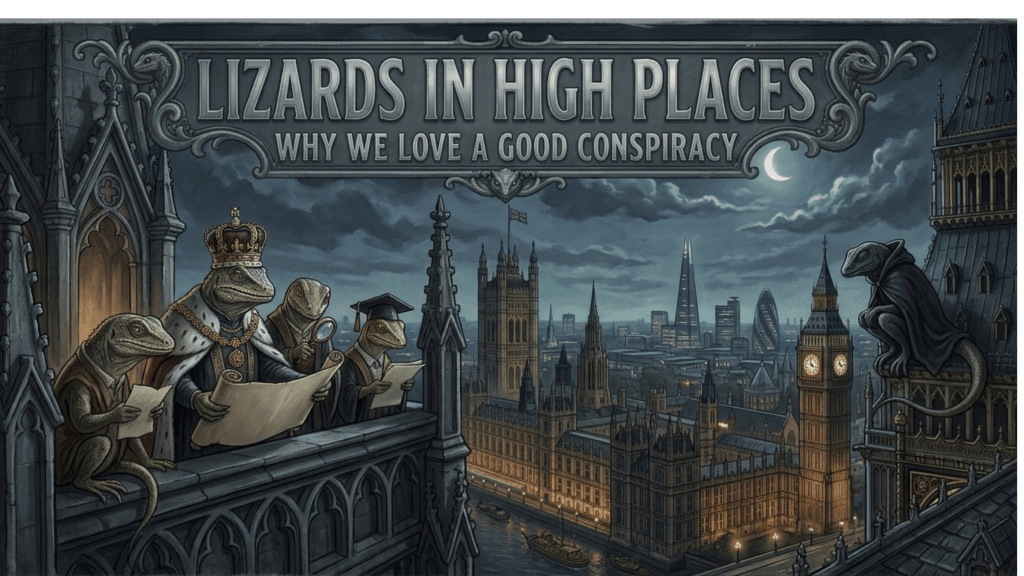
It usually starts with a blurry video. Someone famous and wealthy appears on screen, the picture glitches, and for one frame their eyes look a bit odd. By teatime a red circle has been drawn round the offending pixels and the internet has reached its verdict: lizard.
It is easy to laugh, and you should. But the more interesting question is not whether billionaires are reptiles. They are not. It is why this sort of story keeps turning up, century after century, wearing a different hat each time.
An old story in new clothes
The lizard people are older than the internet. In 1929 the pulp writer Robert E. Howard published a tale about serpent men who disguised themselves as humans and quietly took over a kingdom. In 1983 the television series V gave us alien visitors with reptile faces under rubbery human skin.
Then in 1999 David Icke, once a goalkeeper and BBC sports presenter, published The Biggest Secret. It claimed that shape shifting reptiles from a distant star system had bred their way into royal families, governments and banks. Fiction had quietly become “fact”.
Go back further and the costume changes but the plot does not. Witches were blamed for failed harvests. Secret societies were blamed for revolutions. There is always a hidden group, always pulling strings, always just out of sight.
Why a villain beats a spreadsheet
A conspiracy gives you someone to blame. The real explanations for how the world works are mostly dull and nobody is in charge of them: tax rules, inheritance, institutions, luck. You cannot shake your fist at a pension fund.
The philosopher Karl Popper noticed this back in the 1940s. He called it the conspiracy theory of society: the belief that whenever something bad happens, somebody must have meant it to. It is a strangely comforting idea. If a villain is running things, at least things are being run.
Big effects, boring causes
We expect big things to have big causes. Psychologists call this proportionality bias. A handful of people owning a vast share of the world’s wealth feels as though it needs a dramatic secret behind it.
The true answer is compound interest and friendly tax law, which is hopeless as a story. Nobody ever stayed up until 3am watching videos about capital gains.
Notice, though, that the lizard tale and the boring tale are about the same thing. Both come from an honest unease about power sitting in very few hands. One of them simply asks much less of you. You need not read anything, vote for anything or change anything. You just share the video.
Why now, and why it feels good
These stories bloom when life feels uncertain. Plague years, wars, economic slumps and periods of fast change all produce a fresh crop. When people feel they have lost control, a hidden hand is oddly reassuring.
There is a social reward too. Believing makes you one of the few who can see what is really going on. That is a kind of status, and it costs nothing.
It is worth remembering that these tales are not always harmless fun. The “secret bloodline that runs the world” plot is borrowed almost word for word from old antisemitic myths, and real people have been hurt by stories like it.
The good news
Most people do not believe any of it. One American poll in 2013 put belief in lizard rulers at about 4 percent, and a fair few of those were surely having a laugh. The stories simply travel faster than sober explanations, which makes them look more popular than they are.
So the next time a red circle appears on a blurry neck, enjoy it for what it is: a very old human habit with a new filter on it. Then, if you are feeling brave, ask the duller and better question. Not “who is secretly a lizard?” but “how did things come to be arranged this way, and who could change it?”
The answer is less exciting. It also has the advantage of being true.


Leave a Reply