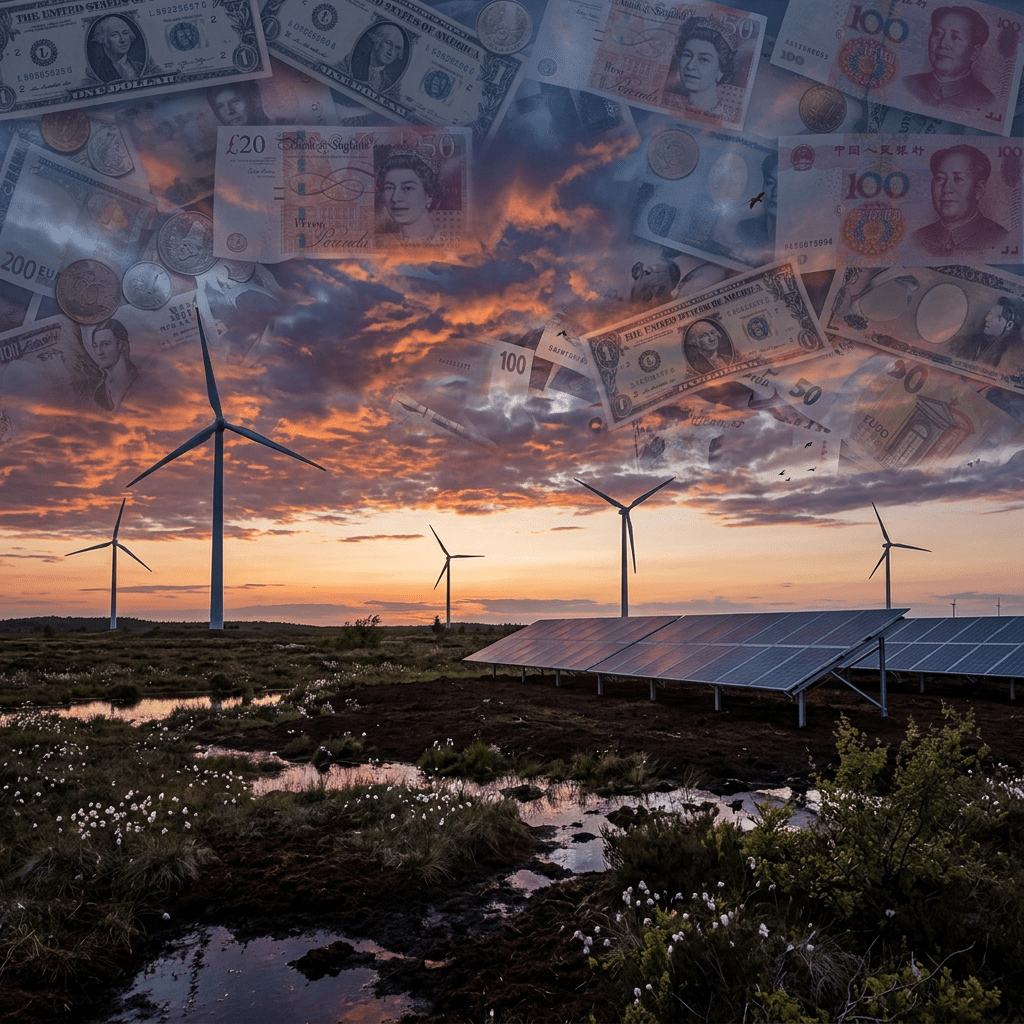
Following the Money: Why Net Zero Ignores Half the Problem
There is a word you will hear constantly in the corridors of government and the boardrooms of energy companies. Net zero. It rolls off the tongue easily, sounds responsible, and comes wrapped in the language of urgency and ambition. But look closely at where the effort actually goes, and a pattern emerges that is worth examining.
The overwhelming focus of net zero policy is on reducing carbon at the source. Wind farms spreading across hillsides and coastlines. Solar panel arrays covering fields that once grew food. Electric vehicle mandates. Heat pumps replacing boilers. These are the flagship solutions, the ones that attract the headlines, the subsidies, and the investment portfolios. Billions of pounds flow toward them, and behind those billions sit shareholders who expect and receive a return.
That is not a conspiracy. It is simply how the economy works. Commercially viable solutions attract commercial investment. There is nothing surprising about it.
What is surprising, or perhaps not surprising at all once you follow the logic, is how little serious attention goes toward the other side of the equation. The earth already has a carbon absorption system. It has been running for millions of years. Forests, peatlands, wetlands, grasslands, ocean ecosystems. These are not theoretical technologies waiting to be developed. They exist right now, and they work.
A healthy peat bog can store more carbon per hectare than almost any other ecosystem on the planet. Ancient forests lock away carbon not just in their trunks and canopies but in the deep, slow complexity of their root systems and soils. Wetlands do the same. These are not modest contributions. They are foundational to any serious attempt to balance the carbon books.
Yet tree planting schemes are chronically underfunded. Peatland restoration moves at a pace that can only be described as leisurely. Ancient woodland continues to be lost to development, roads, and agricultural intensification. The political will simply is not there in the way it is for offshore wind.
And it is not hard to see why. You cannot float a peat bog on the stock exchange. A restored wetland does not generate quarterly earnings reports. Tree planting does not produce dividends. The natural world absorbs carbon quietly, without a business model, and that makes it almost invisible to the systems that drive government policy.
This is the uncomfortable truth at the heart of the net zero project. The solutions that get funded and championed are, by and large, the solutions that make money for someone. The solutions that do not fit that model, no matter how effective, how ancient, or how ecologically sound, are treated as secondary. Nice to have. Aspirational. Something to mention in the smaller print of a policy document.
None of this means that wind and solar are wrong. Reducing emissions at source matters enormously. But treating that as the whole answer is like trying to bail out a flooding boat while ignoring the fact that you could also patch the hull. You need both. The source of the flood and the capacity of the boat to stay afloat.
A genuine net zero strategy would invest in nature on the same scale it invests in technology. It would treat peatland restoration as infrastructure. It would protect ancient woodland with the same legal force it protects energy assets. It would fund community tree planting not as a photo opportunity but as a serious long term carbon strategy.
Until that happens, it is reasonable to ask whether net zero is really about the climate, or whether it is, at least in part, about who gets to make money from the response to it.
That is a question worth sitting with.


Leave a Reply