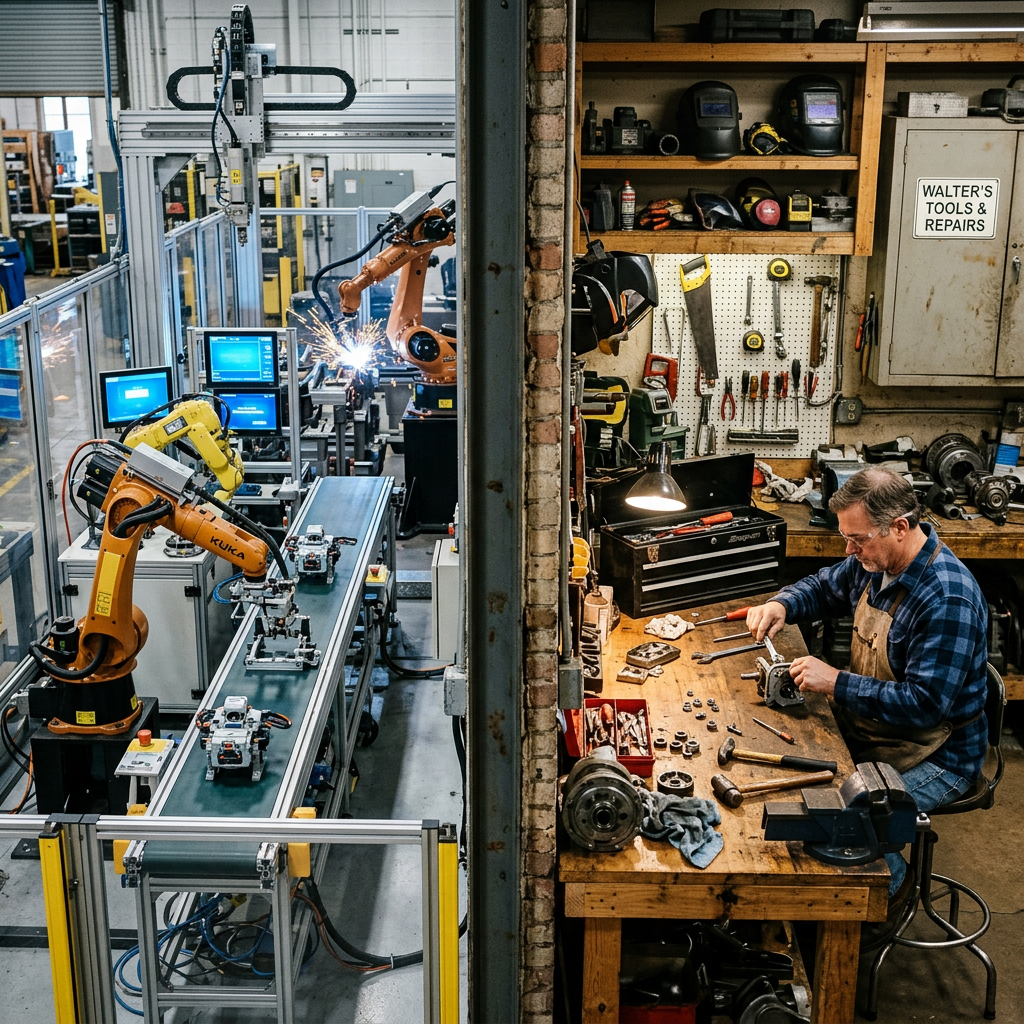
The Real Picture: AI, Human Labour, and the System That Has to Change
Artificial intelligence is already replacing humans in specific, bounded tasks at a pace faster than most institutions are publicly admitting. Routine white-collar work, paralegal research, basic coding, customer service, content drafting, medical image reading, financial analysis. These are not future threats. They are current realities. Millions of entry-level jobs that used to be the foot in the door for building a career are disappearing or being hollowed out right now.
The reassuring argument, repeated endlessly by politicians and tech optimists, is that we have been here before. The industrial revolution displaced agricultural workers and new jobs emerged. The digital revolution automated clerical work and new industries grew. The same will happen again, the argument goes, and humans will simply move into roles that require creativity, empathy, and judgment.
There is some truth in that. But it is not the whole picture.
What is actually AI-proof, and what is not
Physical, hands-on trades are likely to survive longest. Plumbers, electricians, roofers, care workers, cooks in real kitchens. Robots capable of navigating a cluttered domestic space or gently washing an elderly person are far harder to build than software that writes reports and analyses data. These jobs have been consistently undervalued and underpaid, which is one of the deeper ironies of what is coming.
Human-to-human relational work will also hold up. Therapy, spiritual care, teaching young children, community support. People want these things from other people. That may shift over generations but it will not collapse overnight.
Genuine creative work with real originality and personal identity behind it has a future too. A song that audiences know came from a human life, a writer with a distinct voice and moral presence, a painter whose story is part of the work. Not content production, which AI is already dominating at scale, but authentic human expression with an audience that values its source.
High-stakes judgment in genuinely ambiguous situations will remain human for now. Surgeons, senior engineers making calls on complex infrastructure, judges. AI will assist heavily but the liability and the trust still attach to a human.
The uncomfortable truth is that these surviving categories employ a fraction of the current global workforce. The trades cannot absorb hundreds of millions of displaced knowledge workers. Genuine creativity at a level people will pay for is, by definition, not something everyone can do. The mathematics of this do not work without a structural change to how income is distributed across society.
The system has to change, but will it
The two most seriously discussed alternatives to the current model are Universal Basic Income, where everyone receives a livable income floor regardless of employment status, and a significantly shorter working week, where available work is shared more broadly across the population. Both have serious obstacles. Universal basic income requires taxing the productivity gains from AI at a level that powerful corporations will resist with every legal and political tool available to them. Work sharing assumes there is enough work to share, which becomes progressively less true as AI capabilities expand.
What seems more likely in practice, and considerably grimmer, is a prolonged period of social stress before anything coherent is assembled. Wealth will concentrate further. A segment of the population will find meaningful, well-paid work augmenting or directing AI systems. A much larger segment will cycle through precarious, low-wage, task-based work that AI has not yet reached, supplemented by whatever the state is still willing to provide. Political instability tends to follow that kind of divergence. History is consistent on that point.
The question nobody is really asking
The entire framework through which people access food, housing, and dignity in modern societies was built around a world where human labour was the primary input to economic production. That world is ending, not suddenly but steadily and irreversibly. The question is not whether the framework needs to change. It does. The question is whether societies will redesign it deliberately and with some degree of justice, or whether they will allow it to collapse and attempt to rebuild in the wreckage.
The countries most likely to navigate this well will be smaller, with stronger social trust, existing welfare infrastructure, and political cultures comfortable with collective solutions. Those most likely to struggle are the ones where any form of redistribution has been made ideologically toxic, regardless of the evidence in front of them.
The next thirty years will be defined by this tension more than by any other single force. What comes out the other side depends almost entirely on political choices being made right now, by people who are, on the whole, not thinking seriously about them.
That is the real picture.


Leave a Reply