Commentary | War, Wealth and the World’s Poor | April 2026
Billions for Bombs, Pennies for People
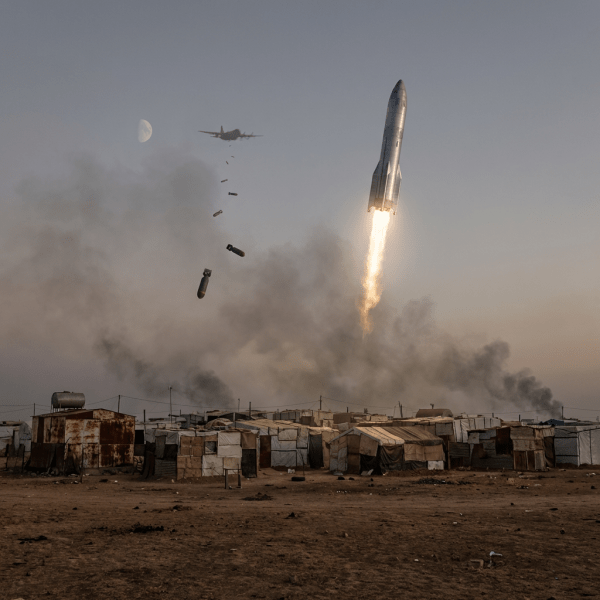
While governments spend without limit on war and space prestige, the world’s most vulnerable are left to count the cost in hunger, illness, and despair.
By John Scotter, Parkinsons Way Community Voice
The Numbers Nobody Wants to Say Out Loud
There is a particular kind of madness that the modern world has normalised so thoroughly that most of us barely flinch when we hear the numbers. One billion dollars a day. Thirty-five billion in five weeks. Ninety-three billion to send four people around the moon and bring them home again. These are not abstract figures in a spreadsheet somewhere. They are choices, deliberate, political, morally weighted choices, made by powerful men and women who have decided that missiles and moon rockets matter more than the millions of human beings who cannot afford a meal, a medicine, or a doctor.
As I write this, the war in Iran, Operation Epic Fury, is burning through roughly a billion US dollars every single day. The Artemis moon programme has spent $93 billion since 2012, with each rocket launch costing more than $4 billion for a single flight. And across the world, in the same week these figures are being reported, 733 million people are hungry. Nearly 700 million live on less than $2.15 a day. Children are dying of diseases that cost pennies to prevent.
“We do not lack the money to end extreme poverty. We lack the will. And when we choose war instead, we are making a moral statement, whether we admit it or not.”
The Real Cost of Conflict
The direct military price tag of the Iran war is staggering enough, but it is only the beginning. When Iran closed the Strait of Hormuz, through which roughly a fifth of the world’s oil passes, energy prices spiked across the globe. Diesel surged 34% in a matter of days. Food prices, already strained by years of supply disruption, crept higher still. Fertiliser costs rose sharply. For wealthy nations, this is uncomfortable. For the world’s poorest, price spikes like these can be the difference between eating and not eating. The conflict in the Middle East is not contained to the Middle East. It radiates outward, invisibly, and it is always the most vulnerable who absorb the shock.
Add to this the $21.7 billion in military aid provided to Israel since October 2023, and the tens of billions spent on air defence systems, carrier strike groups, and munitions that are fired once and gone forever, and you begin to grasp the truly colossal scale of what is being discarded. Not invested. Not built. Discarded, in fire and smoke, over the skies of Iran.
What War Costs vs. What It Could Buy
What is being spent on war:
- $35 billion in US Iran war spending to 1 April 2026
- $4.1 billion per single Artemis rocket launch
- $4 million per Patriot interceptor missile
- $21.7 billion in US military aid to Israel since October 2023
- $1 billion per day, ongoing
What that money could do instead:
- $40 billion could end global malaria for a decade
- $30 billion could provide clean water to everyone who currently lacks it
- $6 billion could end world hunger for a year, according to United Nations estimates
- $2 billion could vaccinate every child on Earth
- $1 billion could fund 10 million sight-restoring cataract operations
Prestige, Power, and the Theatre of Progress
The Artemis programme is sold to us as humanity’s glorious return to the Moon, a vision of exploration, discovery, and the indomitable human spirit. And there is, genuinely, something stirring about the idea. But when the price tag reaches $93 billion, with each launch costing more than four billion dollars for a mission that does not yet even land on the Moon, we are entitled to ask some hard questions. The same sum that has been spent getting four astronauts around the Moon and back could have ended global hunger, by the United Nations’ own reckoning, many times over.
This is not an argument against science or exploration. It is an argument against priorities so badly distorted by politics, ego, and the defence-industrial complex that we have collectively stopped noticing the obscenity. When the Trump administration’s own budget office describes the Space Launch System as “grossly expensive” and “140% over budget,” and the response is simply to keep spending, something has gone deeply, structurally wrong.
“History will not judge us by how far our rockets flew. It will judge us by how we treated the least of these, the hungry, the sick, the displaced, the forgotten.”
The Human Beings Behind the Numbers
Numbers are easy to dismiss, so let us try to be concrete. In the same week that the Pentagon was briefing Congress on an $11.3 billion first-week war bill, the UN World Food Programme was warning of funding shortfalls that would force it to cut rations to millions of refugees in Sudan. In the same month that Artemis II lifted off on its $4 billion moon loop, NHS waiting lists in Britain were stretching to record lengths. In the same quarter that the Strait of Hormuz disruption sent oil prices above $100 a barrel, families in the global south were watching food prices climb beyond reach.
These are not coincidences. They are consequences. When the richest nations on earth pour their treasure into bombs and rockets, the neglect of everything else does not go unfelt. The 3.2 million people displaced inside Iran by the current conflict are real human beings. The 13 American service members killed are real human beings. The civilians counted among the thousands of dead are real human beings. Every one of them is someone’s child, someone’s parent, someone’s beloved.
What We Should Be Asking
We should be asking our governments, loudly and persistently, why billions can be found for war within hours of a political decision, yet years of negotiation cannot produce a fraction of that sum for global health, clean water, or food security. We should be asking why the political will to launch a carrier strike group materialises almost overnight, while the political will to tackle poverty, climate displacement, and preventable disease remains perpetually “aspirational.” We should be asking who profits, because someone always does, and whether those profits are worth the human cost being borne by people who had no voice in the decision.
For those of us in the Parkinson’s community, and in any community that has ever had to fight for funding, for recognition, for basic care, this disproportion should feel particularly sharp. We know what it is to be told there is no money. We know the exhaustion of making the case, again and again, for the resources that would make life bearable. And then we watch, with weary eyes, as the billions flow without hesitation toward the next conflict, the next prestige project, the next theatre of power.
A Crisis of Conscience, Not Scarcity
There is enough wealth in the world to feed every hungry person, to house every displaced family, to treat every preventable illness. The crisis is not one of scarcity. It is one of conscience. And until we, as a global community, demand that our leaders govern by conscience rather than by the calculations of power, the bombs will keep falling, the rockets will keep flying, and the world’s poorest will keep paying a price they did not choose.
It does not have to be this way. But it will remain this way, until enough of us decide that it should not.


 John Scotter Blog