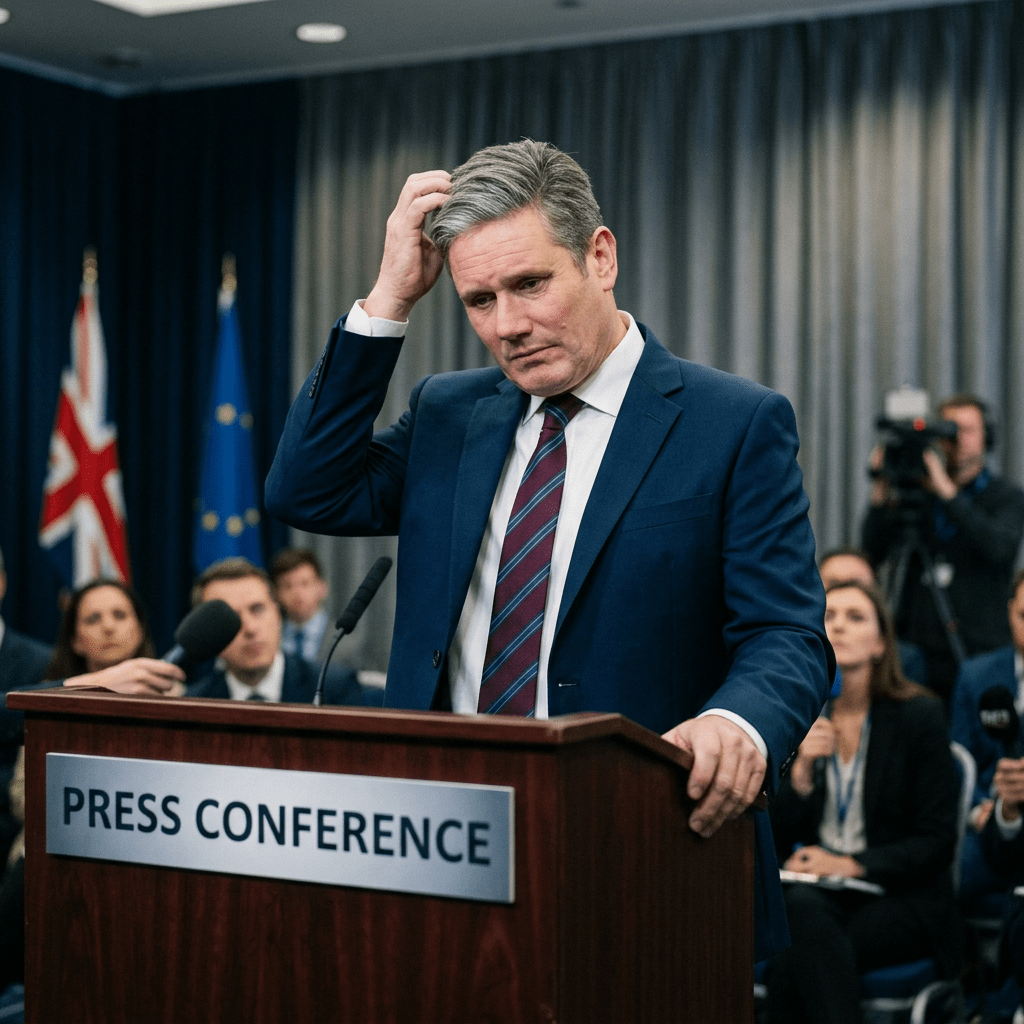
The Mandelson Scandal: Impact on Starmer’s Authority

Is Keir Starmer Finished? The Facts Behind the Headlines

There is a question circulating in British political life right now that goes beyond the usual Westminster gossip. Is Keir Starmer a prime minister in his final months of meaningful authority, or will he somehow survive the gathering storm? To answer it honestly, we need to set aside the media noise and look at where things actually stand.

The Numbers Are Brutal

You can dismiss polls as snapshots, and politicians do so constantly when the numbers are against them. But when an Ipsos survey records just 13% of the public as satisfied with a prime minister’s performance, with 79% dissatisfied and a net approval rating of minus 66, that is not a snapshot. That is a portrait of a government that has lost the country. According to Ipsos records going back to 1977, no sitting prime minister has been this unpopular.

Starmer came to power in July 2024 with the largest Labour majority in modern history. Less than two years later, polling experts are predicting net losses of more than 2,000 council seats in the May 7 local elections, Labour is projected to lose control of Wales for the first time since 1922, and Scottish Labour is expected to fall to third place at Holyrood. These are not the numbers of a government that has hit a rough patch. These are the numbers of a government in structural collapse.

The Mandelson Affair: What Actually Happened

The story that has done the most immediate damage is the Peter Mandelson security vetting scandal, and it is worth understanding what actually occurred rather than what the media has chosen to emphasise.

Mandelson was appointed UK ambassador to the United States in December 2024 and took up the role in February 2025. The security vetting process conducted by UK Security Vetting (UKSV) recommended that his clearance be denied. The Foreign Office then took the rare and extraordinary step of overriding that recommendation, granting him Developed Vetting clearance and allowing him to proceed.

Starmer says he knew nothing of this. That claim is technically possible. Under the UK system, the detailed findings of a security vetting process are never shared with ministers. The result is presented as binary: cleared or not cleared. What Starmer cannot so easily explain is why no one in Downing Street was informed that a security denial had been overridden for his own chosen ambassador. That is not a technical detail. That is a fundamental failure of accountability within his own government.

The top Foreign Office civil servant, Olly Robbins, has since resigned, taking formal responsibility for the override decision. But the political damage has spread far beyond any single official.

A Pattern of Judgment Failures

The Mandelson appointment did not happen in isolation. Documents released by the government in March 2026, after Parliament forced their publication, showed that Starmer had been warned before the announcement of a general reputational risk connected to Mandelson’s long association with Jeffrey Epstein. He proceeded anyway.

Mandelson has since resigned from both the Labour Party and the House of Lords. He is under police investigation on suspicion of leaking government documents to Epstein. Starmer has called his former ambassador’s conduct a litany of deceit and has apologised for making the appointment.

But here is the harder truth. Mandelson did not change who he was between December 2024 and the point the scandal broke. The information that has damaged Starmer was largely knowable at the time of appointment. That is not a story about being misled. That is a story about a prime minister who chose to ignore what was in front of him because the political calculation seemed to favour it.

The Bigger Picture

Beyond Mandelson, the pattern is consistent. Starmer’s deputy Angela Rayner resigned over a tax scandal in September 2025. His Chief of Staff Morgan McSweeney resigned in February 2026. His Director of Communications Tim Allan followed days later. The Cabinet Secretary is reportedly negotiating his own departure.

When the people immediately around a prime minister begin to fall in rapid succession, it rarely reflects a series of unconnected coincidences. It usually reflects a political operation that has lost its coherence.

Will He Survive?

Almost certainly in the short term, yes. Labour’s parliamentary majority is enormous, and the internal party machinery is not ready to move against him. There is no agreed successor. A leadership contest this early into a government would be seen by many Labour MPs as a gift to the opposition, and most will stay quiet whatever they think privately.

But surviving in office is not the same as governing effectively. A prime minister who polls at minus 66, who has lost control of the narrative around his own government, and whose closest advisers have abandoned him, does not recover. History is unkind to leaders who reach this point. They may retain the title, but the authority to lead drains away and does not return.

The May 7 local elections will not end Starmer’s tenure on the night. But if the results are as bad as predicted, he will be governing on borrowed time, sustained not by confidence in his leadership but by the absence of an agreed alternative.

A Final Thought

What this episode reveals most starkly is not the detail of who knew what about a security clearance. It is the broader question of political judgment. Starmer built his reputation as a careful, methodical lawyer who weighed evidence before acting. The Mandelson appointment suggests that reputation may have been overstated. When the political prize seemed attractive enough, the caution disappeared.

That is the kind of revelation that tends to follow a politician for the rest of their career. The question now is how much of that career remains.

Website Powered by WordPress.com.

Up ↑