The War Nobody Talks About in Climate Terms

The conflict in Iran is being reported as a military and geopolitical story. It is also an environmental catastrophe and the world has barely noticed.

When Israeli and US forces launched Operation Epic Fury on 28 February 2026, the immediate headlines focused on targets hit, missiles fired, and diplomatic fallout. What received far less attention was what was pouring into the air, the soil, the sea and the atmosphere.

Black Rain Over Tehran

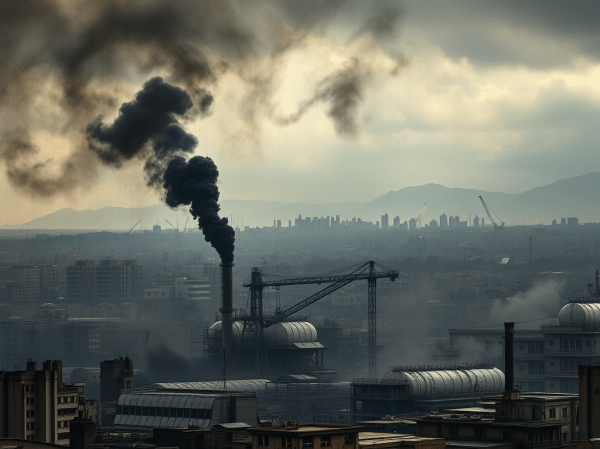
On the nights of 7 and 8 March, airstrikes hit four major oil facilities in and around Tehran. The city, home to nine million people, filled with carbon monoxide, sulphur dioxide, nitrogen oxides, soot and heavy metals. Hemmed in by mountains, the pollution had nowhere to go. It pushed down into the streets.

When rain finally came, it didn’t clean the air it turned oily and black. Residents reported sore throats, burning eyes, and sooty residue coating their homes and cars. Tehran’s “black rain” became an image of what modern industrial warfare does to civilian environments. It also left behind a legacy of contaminated soil and groundwater that will take years to assess.

A Polluted Sea With Nowhere to Drain

The Persian Gulf is shallow and almost entirely enclosed. Around 20 ships have been targeted so far, including oil tankers, and Iranian naval vessels have been sunk. More than 85 large oil tankers remain trapped in the Gulf, each one a potential catastrophe in waiting.

The Gulf’s coral reefs, seagrass beds and desalination plants on which millions of people depend for fresh water are all at serious risk. In an open ocean, a spill disperses. In the Persian Gulf, it accumulates.

The Numbers Behind the Smoke

In just the first two weeks of the conflict 28 February to 14 March the war generated almost 5.6 million tonnes of CO2 equivalent. That is more than the entire annual emissions of Iceland or Kuwait, and roughly equal to the combined yearly output of the world’s 84 lowest emitting countries. All of it released in a fortnight.

The destruction of around 20,000 civilian buildings accounts for the largest single share. Military fuel consumption jets, warships, and ground vehicles burning an estimated 150 to 270 million litres of fuel in those two weeks added over half a million tonnes more.

The Methane Wildcard

Then came the strikes on South Pars, the world’s largest natural gas field, in mid-March. This is where the story takes a grimmer turn.

Methane, the main component of natural gas, is 28 to 34 times more potent as a greenhouse gas than CO2 over a 100 year period, and far worse in the short term. When gas infrastructure is destroyed rather than burned, methane is released directly into the atmosphere unburned. Initial assessments suggest damaged facilities at South Pars may be releasing millions of cubic metres per day. There is no real modern precedent for this scale of gas field destruction in a conflict zone.

A Conflict With a Long Climate Tail

Wars don’t end when the shooting stops, not climatically. Russia’s war in Ukraine, now four years old, has generated greenhouse gas emissions equivalent to France’s entire annual output. The Iran conflict, at its current pace and with the South Pars damage factored in, may exceed that.

After the ceasefire, whenever it comes, tens of thousands of destroyed buildings will need to be rebuilt. Military budgets across the region and the world are rising sharply in response to the conflict, and higher military spending means higher military emissions. The environmental clock keeps running long after the last bomb falls.

What This Means for the Planet

Climate scientists calculate that humanity’s remaining carbon budget, the emissions we can still release while keeping warming below 1.5°C, is already desperately thin. Sudden spikes driven by conflict eat into that budget in ways that cannot be reclaimed. They also historically trigger increased fossil fuel investment as governments scramble to stabilise energy supply, pushing emissions higher still for years to come.

By 10 March, the Conflict and Environment Observatory had logged over 300 environmentally significant incidents across Iran, Iraq, Israel, Kuwait, Jordan, Cyprus, Bahrain, Qatar, the UAE, Saudi Arabia and Oman. The full accounting hasn’t begun yet.

We talk about the climate crisis as though it exists separately from war. It doesn’t. Every conflict is also an environmental event. This one, fought over and around some of the world’s largest fossil fuel infrastructure, may be among the most consequential we have seen.

Sources: Conflict and Environment Observatory (CEOBS); climate analysis from environmental research groups tracking the conflict; reported airstrikes on Iranian oil and gas infrastructure, March 2026.
Trump’s NATO Comments: What He Actually Said

There’s been significant controversy over President Trump’s recent remarks about NATO, with UK politicians expressing outrage. But it’s worth looking at what he actually said and the broader context.

The Key Point Everyone’s Missing:

Trump never mentioned the UK or Britain specifically. His comments were about NATO as an alliance and whether all member nations have been pulling their weight. This is a concern he’s raised consistently for years about defense spending commitments.

What Trump Actually Said:

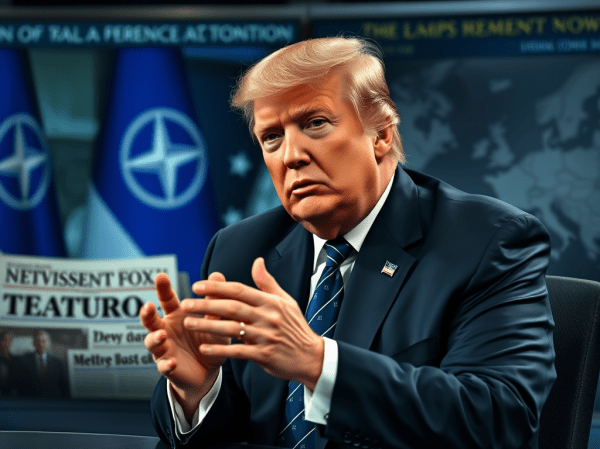
In his Fox News interview, Trump questioned whether NATO allies would support America if needed, and noted that when allies sent troops to places like Afghanistan, some “stayed a little back, a little off the front lines.” These were general observations about the alliance, not targeted at any specific country.

The Broader Context:

Trump has long argued that many NATO countries haven’t met their defense spending obligations (2% of GDP), leaving the US to shoulder a disproportionate burden. He’s pushed allies to increase their contributions – a policy that has actually resulted in more European defense spending.

Why This Matters:

When Trump talks about NATO support, he’s addressing a legitimate question about burden sharing within the alliance. The fact that some countries immediately assumed he was talking about them might say more about their own insecurities than about what Trump actually meant.

The UK has been one of the few NATO allies consistently meeting defense spending targets and has a strong military partnership with the US. It’s unlikely Trump’s comments were directed at them, despite the political and media reaction.

There’s been wall-to-wall coverage of President Trump’s NATO remarks, with UK media and politicians expressing outrage. But a closer examination reveals how a general statement about alliance burden-sharing was transformed into an international incident – and raises questions about media framing in the Trump era.
What Trump Actually Said vs. What Was Reported:
Trump made general observations about NATO in a Fox News interview: questioning whether all allies would support America if needed, and noting that some troops in Afghanistan “stayed a little back, a little off the front lines.” He never mentioned the UK, Britain, or any specific country.
Yet within hours, this became framed as “Trump insults British war dead” and “Trump dismisses UK sacrifice.” The shift from general NATO commentary to specific attack on Britain happened entirely in the interpretation, not in Trump’s actual words.
The Media Pattern:
This follows a familiar pattern we’ve seen repeatedly:
1. Trump makes a broad policy statement or general observation
2. Media outlets interpret it in the most inflammatory way possible
3. Politicians react to the media interpretation, not the original statement
4. The reaction becomes the story, drowning out what was actually said
5. Corrections or context rarely get the same prominence as the initial outrage.

Why This Matters:
Trump has raised NATO burden-sharing concerns for nearly a decade. It’s a legitimate policy position  many European nations haven’t met their 2% GDP defence spending commitments, and the US has carried a disproportionate share of NATO’s costs and military deployments. These are facts, regardless of how one feels about Trump.
But instead of debating the substance. Should NATO members spend more on defense? Is the alliance equitable? The media narrative immediately became about supposed insults and diplomatic damage.

The UK Political Response:
British Prime Minister Keir Starmer called the comments “insulting” and “appalling.” This united UK politicians across parties in condemnation. But consider: Trump didn’t mention the UK. The outrage required British politicians to assume he was talking about them, apply his general comments to Britain specifically, and then react with maximum offense.
One could argue this says more about UK domestic politics than about what Trump meant. Starmer, facing challenges at home, had an opportunity to look strong by confronting Trump. The Conservative opposition couldn’t defend Trump without looking unpatriotic. The incentive structure pushed everyone toward outrage, regardless of what Trump actually intended.

The Correction That Barely Registered:
Trump later posted on Truth Social praising British soldiers and their sacrifice. This received a fraction of the coverage that the initial controversy generated. The pattern is consistent: inflammatory interpretation gets megaphone treatment, clarification gets footnote treatment.

The Broader Media Context:
Since 2016, much of the mainstream media has operated from a presumption that Trump’s statements should be interpreted in the worst possible light. This isn’t necessarily bias in the traditional sense – many journalists genuinely believe Trump is dangerous and see their role as sounding the alarm. But it creates a systematic distortion where:
∙ Ambiguous statements are read as malicious
∙ General comments become specific attacks
∙ Policy disagreements become character issues
∙ Context is minimized in favor of controversy
What Gets Lost:

The actual policy questions disappear. Should NATO members increase defense spending? Has burden-sharing been equitable? What obligations do alliance members have to each other? These are serious questions that deserve serious debate.
Instead, we get 72-hour outrage cycles that generate heat but no light. Politicians posture, media outlets get clicks, and the underlying issues remain unaddressed.

The Trust Problem:
This pattern has real consequences. When media outlets consistently frame Trump’s statements in the most inflammatory way possible, it erodes trust with audiences who can see the gap between what was said and how it’s reported. People who might be legitimately concerned about Trump’s policies become skeptical of all criticism, dismissing real issues as “more media bias.”
The boy who cried wolf wasn’t wrong about everything – but nobody believed him when it mattered.

A Different Approach:
Imagine if the coverage had been: “Trump Renews NATO Burden-Sharing Criticism  UK Politicians Debate Whether Comments Apply to Britain.” That’s accurate, less inflammatory, and would have allowed for actual policy discussion.
But that doesn’t generate the same engagement, the same political theatre, or the same sense of crisis that drives modern media cycles.

The Bottom Line:
Trump made general comments about NATO. He didn’t mention the UK. The media and UK politicians transformed this into an international incident through interpretation, assumption, and political incentive. The resulting coverage tells us more about how Trump era media operates than about what Trump actually meant or what US UK relations actually look like.
Whether you support Trump or oppose him, this pattern should concern you. Media that prioritizes outrage over accuracy, interpretation over investigation, and reaction over reality serves neither truth nor the public interest.
The NATO burden-sharing question remains legitimate. The UK’s military contributions remain substantial. Trump’s communication style remains unconventional. But none of these facts benefit from being obscured by manufactured controversy.

Perhaps it’s time to ask:

Who benefits when every Trump statement becomes a crisis? And who loses when we can’t discuss policy without performative outrage?

Website Powered by WordPress.com.

Up ↑