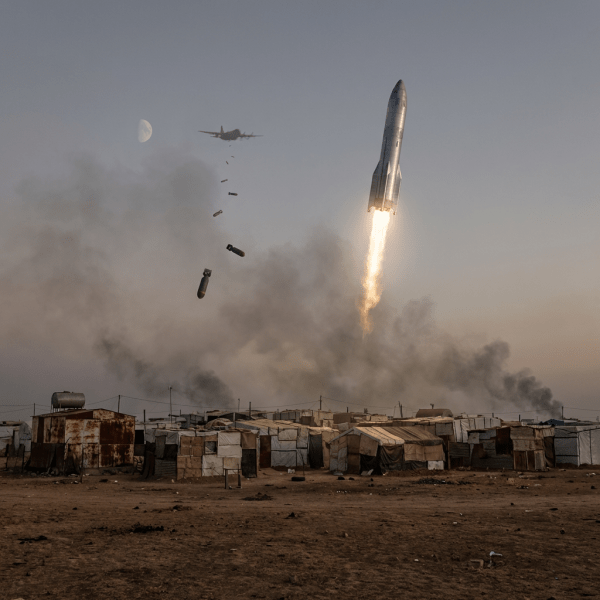
War Spending vs. Global Poverty: A Financial Dilemma

Commentary | War, Wealth and the World’s Poor | April 2026

Billions for Bombs, Pennies for People

While governments spend without limit on war and space prestige, the world’s most vulnerable are left to count the cost in hunger, illness, and despair.

By John Scotter, Parkinsons Way Community Voice


The Numbers Nobody Wants to Say Out Loud

There is a particular kind of madness that the modern world has normalised so thoroughly that most of us barely flinch when we hear the numbers. One billion dollars a day. Thirty-five billion in five weeks. Ninety-three billion to send four people around the moon and bring them home again. These are not abstract figures in a spreadsheet somewhere. They are choices, deliberate, political, morally weighted choices, made by powerful men and women who have decided that missiles and moon rockets matter more than the millions of human beings who cannot afford a meal, a medicine, or a doctor.

As I write this, the war in Iran, Operation Epic Fury, is burning through roughly a billion US dollars every single day. The Artemis moon programme has spent $93 billion since 2012, with each rocket launch costing more than $4 billion for a single flight. And across the world, in the same week these figures are being reported, 733 million people are hungry. Nearly 700 million live on less than $2.15 a day. Children are dying of diseases that cost pennies to prevent.

“We do not lack the money to end extreme poverty. We lack the will. And when we choose war instead, we are making a moral statement, whether we admit it or not.”


The Real Cost of Conflict

The direct military price tag of the Iran war is staggering enough, but it is only the beginning. When Iran closed the Strait of Hormuz, through which roughly a fifth of the world’s oil passes, energy prices spiked across the globe. Diesel surged 34% in a matter of days. Food prices, already strained by years of supply disruption, crept higher still. Fertiliser costs rose sharply. For wealthy nations, this is uncomfortable. For the world’s poorest, price spikes like these can be the difference between eating and not eating. The conflict in the Middle East is not contained to the Middle East. It radiates outward, invisibly, and it is always the most vulnerable who absorb the shock.

Add to this the $21.7 billion in military aid provided to Israel since October 2023, and the tens of billions spent on air defence systems, carrier strike groups, and munitions that are fired once and gone forever, and you begin to grasp the truly colossal scale of what is being discarded. Not invested. Not built. Discarded, in fire and smoke, over the skies of Iran.

What War Costs vs. What It Could Buy

What is being spent on war:

  • $35 billion in US Iran war spending to 1 April 2026
  • $4.1 billion per single Artemis rocket launch
  • $4 million per Patriot interceptor missile
  • $21.7 billion in US military aid to Israel since October 2023
  • $1 billion per day, ongoing

What that money could do instead:

  • $40 billion could end global malaria for a decade
  • $30 billion could provide clean water to everyone who currently lacks it
  • $6 billion could end world hunger for a year, according to United Nations estimates
  • $2 billion could vaccinate every child on Earth
  • $1 billion could fund 10 million sight-restoring cataract operations

Prestige, Power, and the Theatre of Progress

The Artemis programme is sold to us as humanity’s glorious return to the Moon, a vision of exploration, discovery, and the indomitable human spirit. And there is, genuinely, something stirring about the idea. But when the price tag reaches $93 billion, with each launch costing more than four billion dollars for a mission that does not yet even land on the Moon, we are entitled to ask some hard questions. The same sum that has been spent getting four astronauts around the Moon and back could have ended global hunger, by the United Nations’ own reckoning, many times over.

This is not an argument against science or exploration. It is an argument against priorities so badly distorted by politics, ego, and the defence-industrial complex that we have collectively stopped noticing the obscenity. When the Trump administration’s own budget office describes the Space Launch System as “grossly expensive” and “140% over budget,” and the response is simply to keep spending, something has gone deeply, structurally wrong.

“History will not judge us by how far our rockets flew. It will judge us by how we treated the least of these, the hungry, the sick, the displaced, the forgotten.”


The Human Beings Behind the Numbers

Numbers are easy to dismiss, so let us try to be concrete. In the same week that the Pentagon was briefing Congress on an $11.3 billion first-week war bill, the UN World Food Programme was warning of funding shortfalls that would force it to cut rations to millions of refugees in Sudan. In the same month that Artemis II lifted off on its $4 billion moon loop, NHS waiting lists in Britain were stretching to record lengths. In the same quarter that the Strait of Hormuz disruption sent oil prices above $100 a barrel, families in the global south were watching food prices climb beyond reach.

These are not coincidences. They are consequences. When the richest nations on earth pour their treasure into bombs and rockets, the neglect of everything else does not go unfelt. The 3.2 million people displaced inside Iran by the current conflict are real human beings. The 13 American service members killed are real human beings. The civilians counted among the thousands of dead are real human beings. Every one of them is someone’s child, someone’s parent, someone’s beloved.


What We Should Be Asking

We should be asking our governments, loudly and persistently, why billions can be found for war within hours of a political decision, yet years of negotiation cannot produce a fraction of that sum for global health, clean water, or food security. We should be asking why the political will to launch a carrier strike group materialises almost overnight, while the political will to tackle poverty, climate displacement, and preventable disease remains perpetually “aspirational.” We should be asking who profits, because someone always does, and whether those profits are worth the human cost being borne by people who had no voice in the decision.

For those of us in the Parkinson’s community, and in any community that has ever had to fight for funding, for recognition, for basic care, this disproportion should feel particularly sharp. We know what it is to be told there is no money. We know the exhaustion of making the case, again and again, for the resources that would make life bearable. And then we watch, with weary eyes, as the billions flow without hesitation toward the next conflict, the next prestige project, the next theatre of power.


A Crisis of Conscience, Not Scarcity

There is enough wealth in the world to feed every hungry person, to house every displaced family, to treat every preventable illness. The crisis is not one of scarcity. It is one of conscience. And until we, as a global community, demand that our leaders govern by conscience rather than by the calculations of power, the bombs will keep falling, the rockets will keep flying, and the world’s poorest will keep paying a price they did not choose.

It does not have to be this way. But it will remain this way, until enough of us decide that it should not.
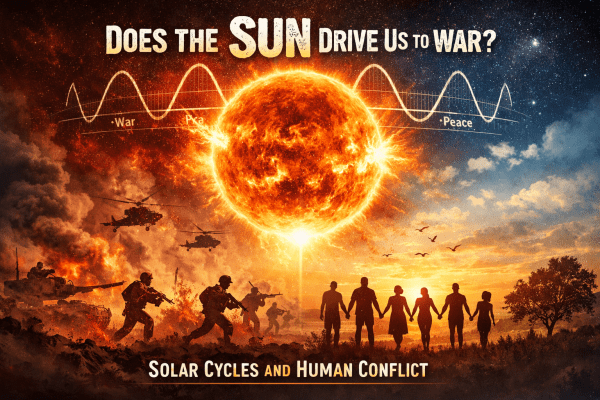

Does the Sun Drive Us to War? Solar Cycles and Human Conflict

Does the Sun Drive Us to War? Solar Cycles and Human Conflict

There is an old idea, dismissed by some and quietly studied by others, that the great drumbeat of human conflict may be keeping time with the sun.

The Solar Cycle

Every eleven years or so, our sun swings between periods of relative calm and intense activity. At solar maximum, sunspot numbers surge, solar flares erupt, and streams of charged particles buffet the Earth’s magnetic field. At solar minimum, things quiet down again. This cycle has been ticking away for as long as the sun has existed long before human beings were around to fight each other.

So what, if anything, does it have to do with war?

The Man Who Asked the Question

The most serious investigator of this idea was a Russian scientist named Alexander Chizhevsky (1897–1964). Working in the early twentieth century, he painstakingly analysed centuries of wars, revolutions, uprisings, and mass social unrest and concluded that roughly 80% of the most significant conflicts in recorded history clustered around solar maximums.

His reward was imprisonment by Stalin. The theory was politically inconvenient, it implied that human behaviour was driven by cosmic forces rather than Marxist economics. History has treated Chizhevsky more kindly than Stalin did, and his work has enjoyed a quiet rehabilitation in recent decades among complexity scientists and researchers interested in solar terrestrial relationships.

American researcher Raymond Wheeler conducted a similar large scale historical analysis in the mid-twentieth century, finding correlations between climate cycles, partly solar driven and periods of war and social upheaval.

How Might It Work?

Three possible pathways have been proposed:

Geomagnetic disturbance. Solar maximums produce more frequent and intense geomagnetic storms. Some researchers suggest these affect human brain chemistry, particularly serotonin and melatonin regulation,  potentially increasing aggression and impulsivity at a population level. This remains speculative but not entirely implausible.

Climate and resource stress. Solar activity influences Earth’s climate modestly. Periods of solar downturn, like the Maunder Minimum of the 17th century,  have been linked to cooling, crop failures, and the kind of resource desperation that historically precedes conflict. Conversely, intense solar activity can bring its own climatic disruptions.

Mass psychology. Some researchers have proposed that heightened solar activity correlates with periods of mass emotional arousal, creative, revolutionary, and destructive all at once. This is the most difficult mechanism to pin down, but it is the one Chizhevsky himself favoured.

The Historical Record

Here is where things get genuinely interesting. Working through the solar cycles from the present day back into history, the alignments, while not perfect, are striking.

Modern Era

Cycle 25 Peak (~2025): We are living through this one. The Russia-Ukraine War, the Israel-Gaza conflict, the Sudanese civil war, and multiple conflicts across the Sahel are all burning simultaneously.

Cycle 24 Peak (~2014): Russia annexed Crimea. ISIS declared its caliphate. The Syrian civil war reached new intensity. The Libyan civil war reignited.

Cycle 23 Peak (~2000): The Second Intifada began. The Congo War intensified. Sierra Leone’s civil war reached its worst phase. Afghanistan simmered under the Taliban ahead of the 9/11 attacks.

Cycle 22 Peak (~1989–1990): The Soviet-Afghan War ended but unleashed regional chaos. Iraq invaded Kuwait. Romania’s revolution turned violent.

Cycle 21 Peak (~1979–1980): The Soviet invasion of Afghanistan. The Iranian Revolution and the beginning of the Iran-Iraq War. The Sino-Vietnamese War.

Cycle 20 Peak (~1968–1969): The Vietnam War reached peak intensity with the Tet Offensive. The War of Attrition followed the Six-Day War. The Soviet Union invaded Czechoslovakia. Mass civil unrest erupted across France, the United States, and Mexico simultaneously.

The Cold War and World War Years

Cycle 19 Peak (~1957–1958): This was the strongest solar maximum on record and it coincided with the Hungarian Revolution being crushed, the Suez Crisis aftermath, the Lebanese Crisis, and the Algerian War of Independence at full intensity.

Cycle 18 Peak (~1947–1948): The Greek Civil War. The partition of India and Pakistan with its catastrophic accompanying violence. The Israeli War of Independence. The Chinese Civil War resuming in earnest.

Cycle 17 Peak (~1937–1938):The Second Sino-Japanese War began in 1937,  one of the deadliest theatres of the entire Second World War. The Spanish Civil War was at its height. Nazi Germany annexed Austria.

Cycle 15 Peak (~1917):World War One reached its most catastrophic year, Passchendaele, the Brusilov Offensive’s aftermath, staggering losses on every front. The Russian Revolution overthrew the Tsar. The United States entered the war.

The Nineteenth Century

Cycle 11 Peak (~1870):The Franco Prussian War, one of the most significant conflicts in European history, redrawing the map of the continent and planting the seeds of the First World War.

Cycle 10 Peak (~1860): The American Civil War began in 1861, just after the solar peak. The Taiping Rebellion in China was at its bloodiest. The Second Opium War concluded.

Cycle 9 Peak (~1848):Perhaps the most remarkable alignment in the entire record. In a single year, revolutions erupted simultaneously across virtually the whole of Europe, France, the German states, Austria, Hungary, Italy, and beyond. The “Springtime of Nations” as historians call it arrived, almost to the year, at solar maximum.

Cycle 5 Peak (~1805):The Napoleonic Wars were at full intensity. The Battle of Austerlitz — widely considered Napoleon’s tactical masterpiece, was fought in December 1805.

The Honest Assessment

It would be intellectually dishonest to overstate this. Wars have complex political, economic, ideological, and human causes that dwarf any cosmic influence. With enough conflicts across enough centuries, correlations can be found with almost any recurring cycle, statisticians call this data mining, and it is a legitimate concern.

The alignments are not perfect. The solar peak around 1928, for instance, sits in a relatively quiet period internationally. The pattern has gaps!

What can be said with reasonable confidence is this: the correlation is real enough that serious researchers have studied it across multiple centuries and multiple methodologies. There may be a weak, indirect influence operating through climate stress and possibly neurobiological pathways. But it is a very long way from “interesting statistical pattern” to “the sun causes wars.” Human agency, politics, and economics remain overwhelmingly dominant.

What the solar cycle hypothesis offers is not a deterministic theory of war, but a humbling reminder that human beings are not as separate from the natural world as we like to think. We are embedded in a solar system, affected by its rhythms in ways we are only beginning to understand.

The sun has been burning for five billion years. It will be burning long after the last of our wars is forgotten.

Sources and further reading: Alexander Chizhevsky, “The Earth in the Grip of the Sun” (1926); Raymond Wheeler’s historical climate studies; contemporary research on solar-terrestrial relationships and human biology.

Website Powered by WordPress.com.

Up ↑