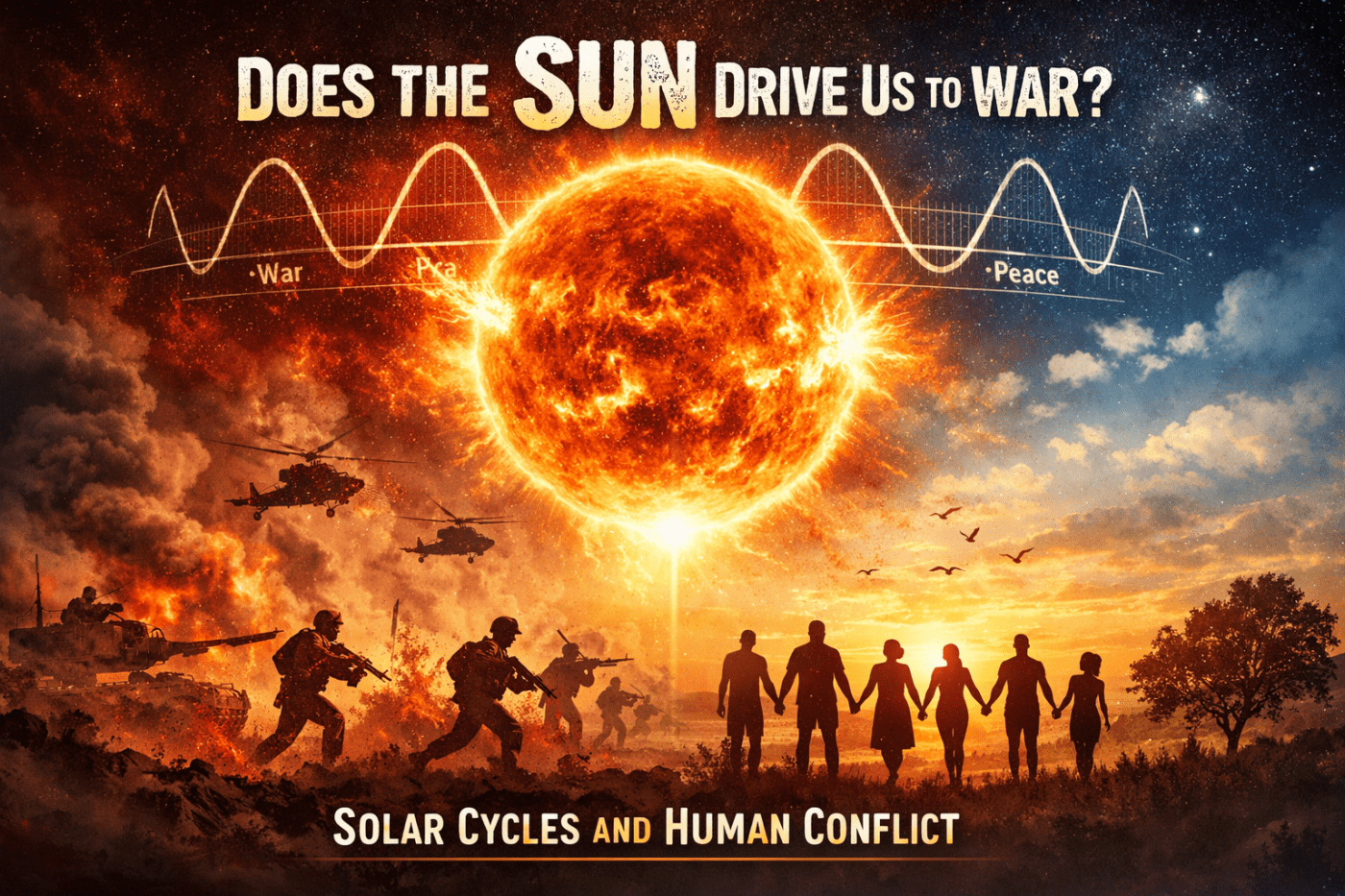
Does the Sun Drive Us to War? Solar Cycles and Human Conflict
There is an old idea, dismissed by some and quietly studied by others, that the great drumbeat of human conflict may be keeping time with the sun.
The Solar Cycle
Every eleven years or so, our sun swings between periods of relative calm and intense activity. At solar maximum, sunspot numbers surge, solar flares erupt, and streams of charged particles buffet the Earth’s magnetic field. At solar minimum, things quiet down again. This cycle has been ticking away for as long as the sun has existed long before human beings were around to fight each other.
So what, if anything, does it have to do with war?
The Man Who Asked the Question
The most serious investigator of this idea was a Russian scientist named Alexander Chizhevsky (1897–1964). Working in the early twentieth century, he painstakingly analysed centuries of wars, revolutions, uprisings, and mass social unrest and concluded that roughly 80% of the most significant conflicts in recorded history clustered around solar maximums.
His reward was imprisonment by Stalin. The theory was politically inconvenient, it implied that human behaviour was driven by cosmic forces rather than Marxist economics. History has treated Chizhevsky more kindly than Stalin did, and his work has enjoyed a quiet rehabilitation in recent decades among complexity scientists and researchers interested in solar terrestrial relationships.
American researcher Raymond Wheeler conducted a similar large scale historical analysis in the mid-twentieth century, finding correlations between climate cycles, partly solar driven and periods of war and social upheaval.
How Might It Work?
Three possible pathways have been proposed:
Geomagnetic disturbance. Solar maximums produce more frequent and intense geomagnetic storms. Some researchers suggest these affect human brain chemistry, particularly serotonin and melatonin regulation, potentially increasing aggression and impulsivity at a population level. This remains speculative but not entirely implausible.
Climate and resource stress. Solar activity influences Earth’s climate modestly. Periods of solar downturn, like the Maunder Minimum of the 17th century, have been linked to cooling, crop failures, and the kind of resource desperation that historically precedes conflict. Conversely, intense solar activity can bring its own climatic disruptions.
Mass psychology. Some researchers have proposed that heightened solar activity correlates with periods of mass emotional arousal, creative, revolutionary, and destructive all at once. This is the most difficult mechanism to pin down, but it is the one Chizhevsky himself favoured.
The Historical Record
Here is where things get genuinely interesting. Working through the solar cycles from the present day back into history, the alignments, while not perfect, are striking.
Modern Era
Cycle 25 Peak (~2025): We are living through this one. The Russia-Ukraine War, the Israel-Gaza conflict, the Sudanese civil war, and multiple conflicts across the Sahel are all burning simultaneously.
Cycle 24 Peak (~2014): Russia annexed Crimea. ISIS declared its caliphate. The Syrian civil war reached new intensity. The Libyan civil war reignited.
Cycle 23 Peak (~2000): The Second Intifada began. The Congo War intensified. Sierra Leone’s civil war reached its worst phase. Afghanistan simmered under the Taliban ahead of the 9/11 attacks.
Cycle 22 Peak (~1989–1990): The Soviet-Afghan War ended but unleashed regional chaos. Iraq invaded Kuwait. Romania’s revolution turned violent.
Cycle 21 Peak (~1979–1980): The Soviet invasion of Afghanistan. The Iranian Revolution and the beginning of the Iran-Iraq War. The Sino-Vietnamese War.
Cycle 20 Peak (~1968–1969): The Vietnam War reached peak intensity with the Tet Offensive. The War of Attrition followed the Six-Day War. The Soviet Union invaded Czechoslovakia. Mass civil unrest erupted across France, the United States, and Mexico simultaneously.
The Cold War and World War Years
Cycle 19 Peak (~1957–1958): This was the strongest solar maximum on record and it coincided with the Hungarian Revolution being crushed, the Suez Crisis aftermath, the Lebanese Crisis, and the Algerian War of Independence at full intensity.
Cycle 18 Peak (~1947–1948): The Greek Civil War. The partition of India and Pakistan with its catastrophic accompanying violence. The Israeli War of Independence. The Chinese Civil War resuming in earnest.
Cycle 17 Peak (~1937–1938):The Second Sino-Japanese War began in 1937, one of the deadliest theatres of the entire Second World War. The Spanish Civil War was at its height. Nazi Germany annexed Austria.
Cycle 15 Peak (~1917):World War One reached its most catastrophic year, Passchendaele, the Brusilov Offensive’s aftermath, staggering losses on every front. The Russian Revolution overthrew the Tsar. The United States entered the war.
The Nineteenth Century
Cycle 11 Peak (~1870):The Franco Prussian War, one of the most significant conflicts in European history, redrawing the map of the continent and planting the seeds of the First World War.
Cycle 10 Peak (~1860): The American Civil War began in 1861, just after the solar peak. The Taiping Rebellion in China was at its bloodiest. The Second Opium War concluded.
Cycle 9 Peak (~1848):Perhaps the most remarkable alignment in the entire record. In a single year, revolutions erupted simultaneously across virtually the whole of Europe, France, the German states, Austria, Hungary, Italy, and beyond. The “Springtime of Nations” as historians call it arrived, almost to the year, at solar maximum.
Cycle 5 Peak (~1805):The Napoleonic Wars were at full intensity. The Battle of Austerlitz — widely considered Napoleon’s tactical masterpiece, was fought in December 1805.
The Honest Assessment
It would be intellectually dishonest to overstate this. Wars have complex political, economic, ideological, and human causes that dwarf any cosmic influence. With enough conflicts across enough centuries, correlations can be found with almost any recurring cycle, statisticians call this data mining, and it is a legitimate concern.
The alignments are not perfect. The solar peak around 1928, for instance, sits in a relatively quiet period internationally. The pattern has gaps!
What can be said with reasonable confidence is this: the correlation is real enough that serious researchers have studied it across multiple centuries and multiple methodologies. There may be a weak, indirect influence operating through climate stress and possibly neurobiological pathways. But it is a very long way from “interesting statistical pattern” to “the sun causes wars.” Human agency, politics, and economics remain overwhelmingly dominant.
What the solar cycle hypothesis offers is not a deterministic theory of war, but a humbling reminder that human beings are not as separate from the natural world as we like to think. We are embedded in a solar system, affected by its rhythms in ways we are only beginning to understand.
The sun has been burning for five billion years. It will be burning long after the last of our wars is forgotten.
Sources and further reading: Alexander Chizhevsky, “The Earth in the Grip of the Sun” (1926); Raymond Wheeler’s historical climate studies; contemporary research on solar-terrestrial relationships and human biology.

 John Scotter Blog
Leave a comment