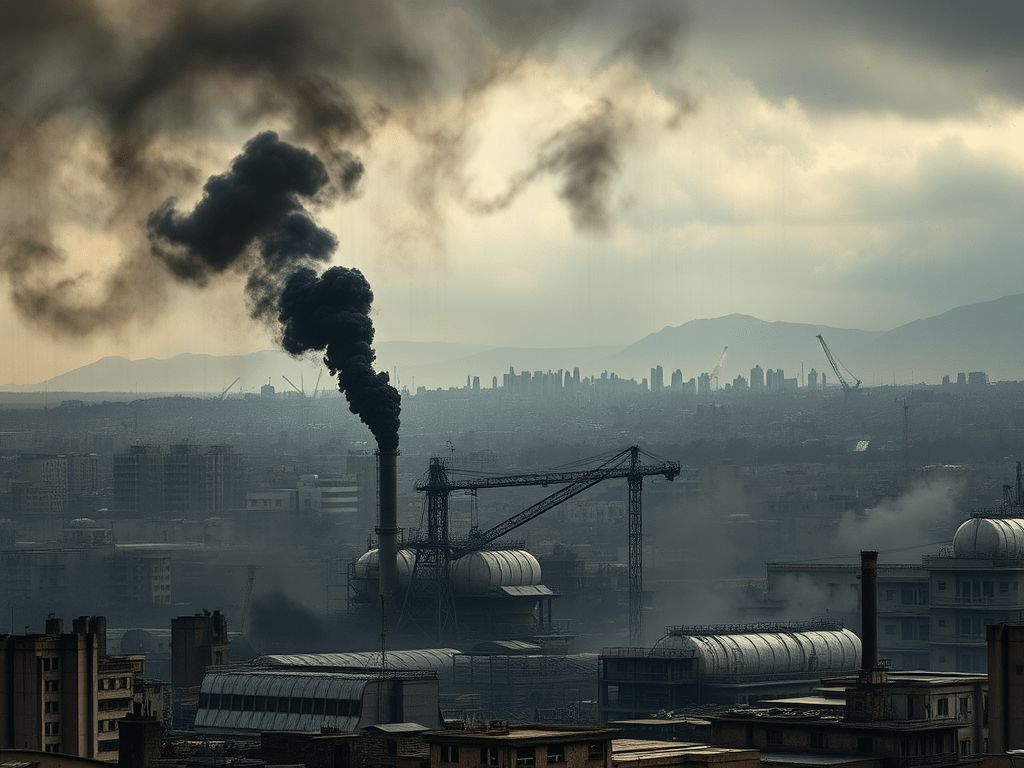
The conflict in Iran is being reported as a military and geopolitical story. It is also an environmental catastrophe and the world has barely noticed.
When Israeli and US forces launched Operation Epic Fury on 28 February 2026, the immediate headlines focused on targets hit, missiles fired, and diplomatic fallout. What received far less attention was what was pouring into the air, the soil, the sea and the atmosphere.
Black Rain Over Tehran
On the nights of 7 and 8 March, airstrikes hit four major oil facilities in and around Tehran. The city, home to nine million people, filled with carbon monoxide, sulphur dioxide, nitrogen oxides, soot and heavy metals. Hemmed in by mountains, the pollution had nowhere to go. It pushed down into the streets.
When rain finally came, it didn’t clean the air it turned oily and black. Residents reported sore throats, burning eyes, and sooty residue coating their homes and cars. Tehran’s “black rain” became an image of what modern industrial warfare does to civilian environments. It also left behind a legacy of contaminated soil and groundwater that will take years to assess.
A Polluted Sea With Nowhere to Drain
The Persian Gulf is shallow and almost entirely enclosed. Around 20 ships have been targeted so far, including oil tankers, and Iranian naval vessels have been sunk. More than 85 large oil tankers remain trapped in the Gulf, each one a potential catastrophe in waiting.
The Gulf’s coral reefs, seagrass beds and desalination plants on which millions of people depend for fresh water are all at serious risk. In an open ocean, a spill disperses. In the Persian Gulf, it accumulates.
The Numbers Behind the Smoke
In just the first two weeks of the conflict 28 February to 14 March the war generated almost 5.6 million tonnes of CO2 equivalent. That is more than the entire annual emissions of Iceland or Kuwait, and roughly equal to the combined yearly output of the world’s 84 lowest emitting countries. All of it released in a fortnight.
The destruction of around 20,000 civilian buildings accounts for the largest single share. Military fuel consumption jets, warships, and ground vehicles burning an estimated 150 to 270 million litres of fuel in those two weeks added over half a million tonnes more.
The Methane Wildcard
Then came the strikes on South Pars, the world’s largest natural gas field, in mid-March. This is where the story takes a grimmer turn.
Methane, the main component of natural gas, is 28 to 34 times more potent as a greenhouse gas than CO2 over a 100 year period, and far worse in the short term. When gas infrastructure is destroyed rather than burned, methane is released directly into the atmosphere unburned. Initial assessments suggest damaged facilities at South Pars may be releasing millions of cubic metres per day. There is no real modern precedent for this scale of gas field destruction in a conflict zone.
A Conflict With a Long Climate Tail
Wars don’t end when the shooting stops, not climatically. Russia’s war in Ukraine, now four years old, has generated greenhouse gas emissions equivalent to France’s entire annual output. The Iran conflict, at its current pace and with the South Pars damage factored in, may exceed that.
After the ceasefire, whenever it comes, tens of thousands of destroyed buildings will need to be rebuilt. Military budgets across the region and the world are rising sharply in response to the conflict, and higher military spending means higher military emissions. The environmental clock keeps running long after the last bomb falls.
What This Means for the Planet
Climate scientists calculate that humanity’s remaining carbon budget, the emissions we can still release while keeping warming below 1.5°C, is already desperately thin. Sudden spikes driven by conflict eat into that budget in ways that cannot be reclaimed. They also historically trigger increased fossil fuel investment as governments scramble to stabilise energy supply, pushing emissions higher still for years to come.
By 10 March, the Conflict and Environment Observatory had logged over 300 environmentally significant incidents across Iran, Iraq, Israel, Kuwait, Jordan, Cyprus, Bahrain, Qatar, the UAE, Saudi Arabia and Oman. The full accounting hasn’t begun yet.
We talk about the climate crisis as though it exists separately from war. It doesn’t. Every conflict is also an environmental event. This one, fought over and around some of the world’s largest fossil fuel infrastructure, may be among the most consequential we have seen.
Sources: Conflict and Environment Observatory (CEOBS); climate analysis from environmental research groups tracking the conflict; reported airstrikes on Iranian oil and gas infrastructure, March 2026.

 John Scotter Blog
Leave a comment